
(The Android Show, Android)
Google is gearing up for a pivotal moment in the fast-accelerating race for spatial computing leadership. On December 8, the company will host a 30-minute Android XR showcase promising fresh details across headsets, glasses, and the next evolution of multimodal AI.
For an industry still digesting the launch of Samsung’s premium Galaxy XR headset, Google’s timing is striking. Is this the moment the Android XR ecosystem shifts from “promising” to “unified”? And perhaps the bigger question: Can Google’s Gemini-powered vision go further than hardware-centric competitors?
The answers may begin unfolding next week…
A New Phase for Android XR – and a Different Kind of Momentum
The Android XR ecosystem has been building steadily, but Google’s upcoming showcase signals a new phase: platform-first, AI-first, and ecosystem-wide. Unlike its brief appearance at Samsung’s event earlier this year, this livestream is Google reclaiming the microphone – and telling the XR world what comes next on its own terms.
The teaser alone hints at breadth:
“Learn about all things XR across glasses, headsets, and everything in between.”
If the Galaxy XR placed a bold stake in the ground for next-gen Android spatial hardware, Google’s December event looks ready to expand the narrative from one device to an entire computing paradigm.
And the industry is asking:
Is this the beginning of Google’s true XR leadership era – one driven less by hardware specs and more by ambient, AI-centred experience design?
Gemini at the Centre of the XR Universe
If early signals are accurate, Gemini will be the gravitational force of Google’s announcement.
For years, XR has wrestled with interface friction – gestures that feel awkward, controllers that feel dated, and voice assistants that feel too limited. Now, Google wants to show how a multimodal, context-aware AI can anchor a new spatial computing model where:
- the camera becomes your “memory”
- your environment becomes an information layer
- interactions become conversational
- assistance becomes anticipatory, not reactive
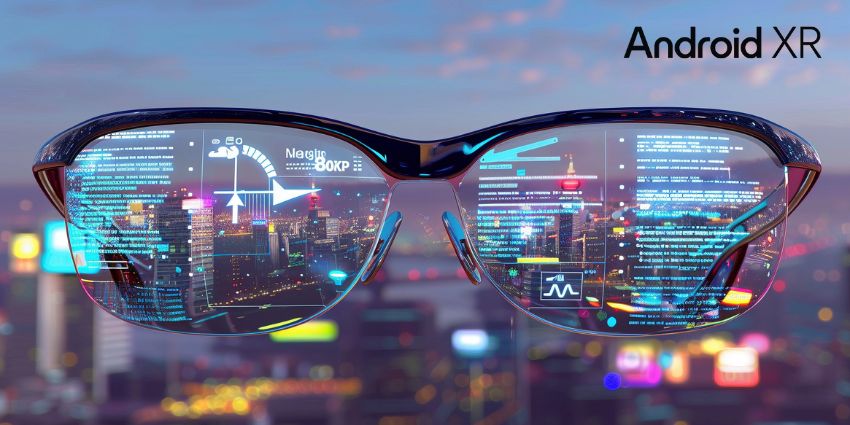
Imagine asking where you left your badge, cables, or keys – and your glasses visually guide you straight to them. Or walking through a city and receiving contextual insights, translated signage, or navigable overlays without breaking stride.
These aren’t distant concepts anymore.
Dec. 8 is expected to show how Gemini becomes the operating system within the operating system.
What We Can Expect Google to Reveal
While Google keeps the specifics tightly sealed, several themes are expected to emerge.
- Deeper Gemini Integration Across All XR Form Factors
Expect demos of Gemini responding to visual context, reshaping productivity workflows, and delivering conversational, hands-free interactions. The goal: XR where AI is the primary interface, not an optional layer.
- A Clearer Picture of the Smart Glasses Roadmap
The teaser prominently features glasses, not headsets, and that’s telling.
Smart glasses represent the inflection point where XR becomes mainstream. Google’s collaborations with eyewear brands hint at a fashion-aligned strategy, and this showcase could be the first time Google openly positions glasses as the centrepiece of its long-term XR ambitions.
- Cross-Device Android Continuity
Spatial sessions that start on a headset and follow you onto glasses or phones.
The Android ecosystem’s real power lies in continuity, and Dec. 8 may finally reveal how spatial computing will weave into your phone, your watch, your tablet, and beyond.
- Third-Party XR Hardware Highlights
With XREAL, Samsung, and others building Android XR devices, don’t be surprised if Google spotlights partner hardware or hints at what’s coming in 2026.
- Spatial Apps and Play Store Evolution
The next Android XR milestone is likely a deeper integration of:
- Maps in immersive mode
- YouTube spatial video zones
- Google Photos layered 3D replays
- Productivity tools adapted for fluid, wearable-first use
With millions of Android apps available, app continuity remains Google’s ace card.
The Samsung Question: Who Sets the Pace?
Samsung may have fired the starting shot with Galaxy XR, but Google’s event could reshape the narrative.
So we are now wondering:
Will Samsung’s hardware lead the ecosystem, or will Google’s AI and platform strategy define the direction?
Final Thoughts
The December 8 Android XR showcase is shaping up as one of Google’s most consequential spatial computing moments in years. XR Today will be covering every announcement, every demo, and every AI-powered reveal.
The next era of XR won’t be defined by hardware specs alone – but by intelligence, context, and seamless integration across everything we wear and carry.
And Google wants the world to know it’s ready to lead.